
You cannot fix the homecare workforce without fixing commissioning

Dr Jane Townson OBE
Chief Executive Officer
Homecare Association
September 2026
Why do people leave care work, and what would persuade more people to join and stay? Research into pay, wellbeing, training, management, and culture can help employers improve working lives.
But in homecare, there is another question we cannot overlook: what kind of jobs does the system make it possible for employers to offer?
That is why the Care Work Partnership matters. Its research into how commissioning shapes pay, conditions and retention gets beneath the symptoms to examine the structures producing them.
Homecare shows the problem starkly. Councils and the NHS buy around 80% of homecare hours, much of it through frameworks that guarantee providers no volume of work and pay in arrears for contact time - sometimes literally the minutes recorded in someone's home. In our research, only 1% of public bodies used block contracts guaranteeing income, while 61% bought no more than 500 hours per provider each week [1].
Three commissioning decisions shape the employment offer: how much local work each provider receives, the price commissioners pay, and whether they pay for planned capacity or individual contact minutes.
When a provider receives a small, unpredictable set of visits scattered across a wide area, it cannot build compact working days. Research by the Health Innovation Network South West in Bristol illustrates the problem (Figure 1) [2]. With six providers across the same area, efficient rounds are far harder to plan, and careworkers spend substantial time travelling and waiting between calls. Their paid hours can fluctuate when someone goes into hospital, dies, or has their package changed. Providers cannot guarantee hours to workers when commissioners guarantee no work to providers.

Figure 1: Careworkers' rounds across six providers on one day in Bristol
This helps explain why around 42% of careworkers in domiciliary care work on zero-hours contracts [3]. Skills for Care evidence also shows that workers with fewer contracted hours are more likely to leave [4].
Modelling shows that grouping the same visits into geographical zones could deliver the same care with 35% less workforce capacity and 65% less mileage (Figure 2) [2]. The aim is not to cut the workforce but to release scarce capacity, so more people can be supported while careworkers gain fuller, better-paid and more secure rounds.
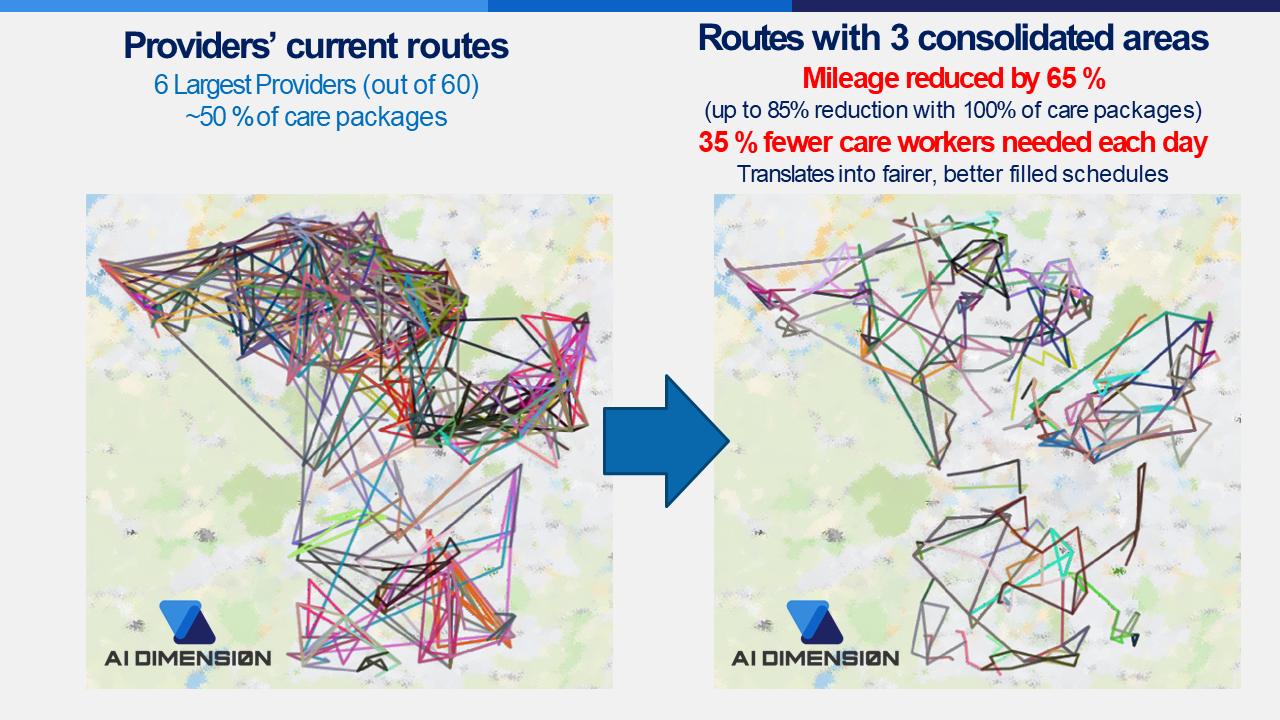
Figure 2: With fewer providers and geographical zoning, the same calls could be delivered using 35% less workforce capacity and 65% less mileage
Price compounds the problem. Our Minimum Price for Homecare in England is £34.42 per hour in 2026/27 [5], yet our latest research found 29% of councils and Health and Social Care Trusts paying average rates below even the direct cost of employing a careworker at the National Living Wage [1]. Before providers can improve pay, training or employment security, the price of care must at least cover the lawful cost of delivering it.
This matters because the Employment Rights Act 2025 seeks greater security through guaranteed hours and compensation for short-notice changes. We support the aim; careworkers deserve predictable work and income. But there is a contradiction in removing one-sided flexibility from employment while public commissioners keep it when buying care. A provider cannot guarantee a careworker's Tuesday if nobody has guaranteed the provider's Tuesday.
This is not theoretical. Councils are still buying care below the cost of lawful delivery, paying by exact contact minutes and spreading work so thinly that individual provider locations have too little predictable volume.
There are better ways. Neighbourhood commissioning can give providers enough work in compact areas to build stable teams and efficient rounds. Block or capacity-based payment can provide the income security to pay workers for whole rounds, including travel and reasonable waiting time, rather than isolated fragments of activity [6]. A fair price then supports proper employment, training, and supervision.
This is where the Care Work Partnership can help. Its research can show which models work, for whom, under what conditions, and with what consequences for workers and people drawing on care. It can also turn promising local practice into evidence strong enough to change national policy.
So yes, we must understand why people join and leave social care. But we must also ask a deeper question: why do we organise and buy homecare in ways that make good jobs so hard to create?
If we want a stable homecare workforce that can grow to meet rising needs, we must create the conditions in which good jobs can flourish.
References:
[1] Homecare Association (2025). The Homecare Deficit 2025.
[2] Health Innovation Network SW (2023). Trial of AI-based optimisation in domiciliary care.
[3] Skills for Care (2025). Summary of domiciliary care services 2025.
[4] Skills for Care (2025). The state of the adult social care sector and workforce in England.
[5] Homecare Association (2025). Minimum Price for Homecare for England, 2026/27.
[6] Skills for Care (2026). Practical approach: Neighbourhood-based block-pay.