
Why are people leaving social care jobs, and what could help them stay?




Wenjing Zhang (Research Fellow, King’s College London)
Ann-Marie Towers (Professor of Social Care Research, King’s College London)
Bo Hu (Associate Professorial Research Fellow, London School of Economics and Political Science)
Annette Boaz (Professor of Health and Social Care, King’s College London)
June 2026
Adult social care depends on skilled, compassionate people. Yet across England, many workers are leaving the sector because the pressures of the job are becoming too difficult to sustain. This matters not only for staff wellbeing, but also for the quality and continuity of care that people receive.
To better understand why people leave adult social care and what might have encouraged them to stay, we carried out a study with former adult social care workers in England. The research builds on a 2023 national survey of more than 7,000 people working in adult social care in England. Around one in three said they intended to leave their job as soon as they found another one, with low pay, stress and burnout identified as the main reasons. By 2025, 12% of those who took part in a follow-up survey (1,073 people) had left adult social care altogether, including a small number who did not intend to quit two years earlier.
To better understand these decisions, we interviewed 30 people who had left adult social care roles within the previous two years. Participants included care workers, social workers, occupational therapists, personal assistants and managers. Some had moved into jobs in other sectors, while others had retired early or left work altogether because of health or caring responsibilities. Although every story was different, common themes emerged.
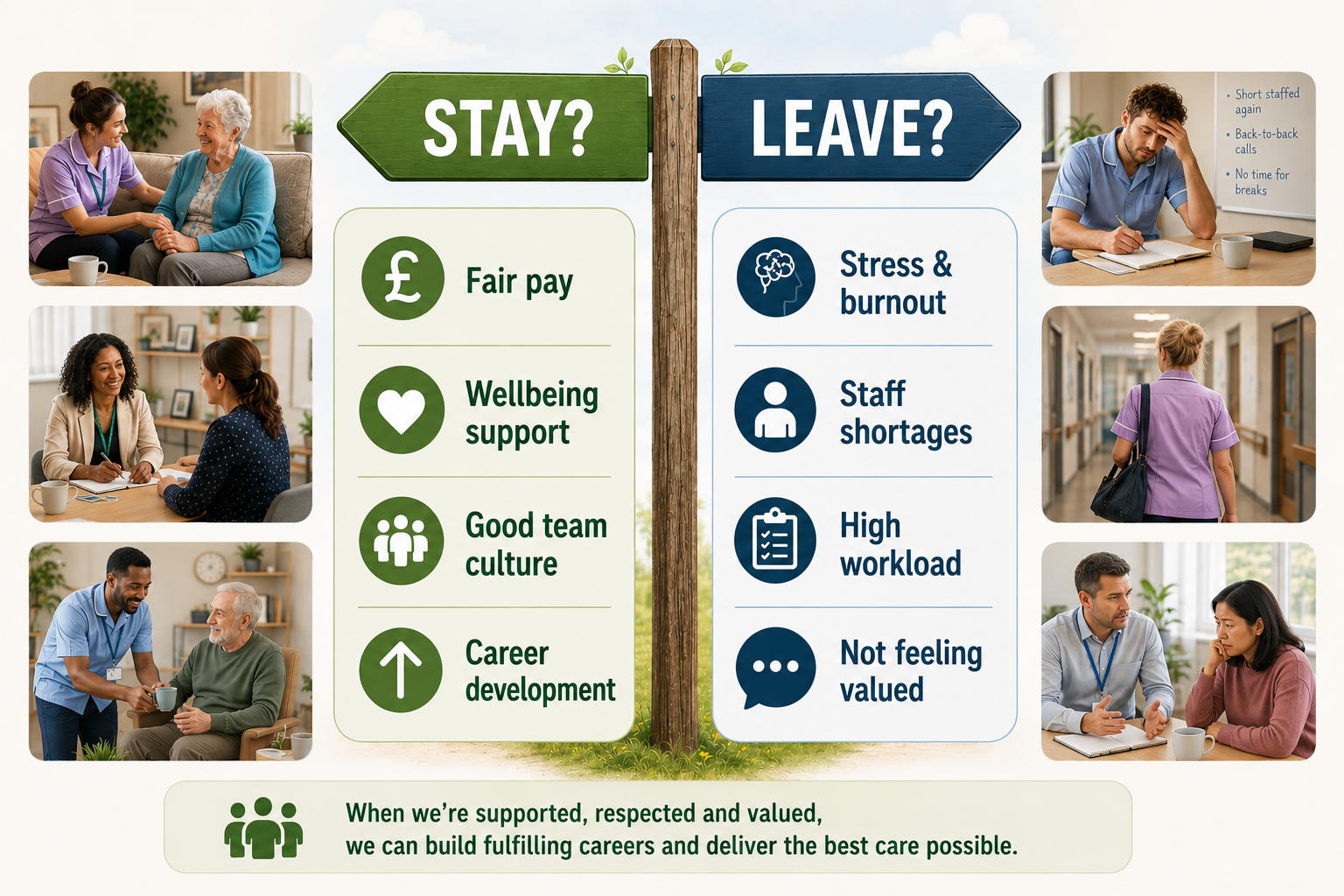
Image produced by ChatGPT
Leaving was rarely a sudden decision
For most participants, leaving social care was not caused by a single event. Instead, it reflected an accumulation of pressures over time.
Workers described ongoing staffing shortages, increasing workloads and limited resources. Many felt they were constantly trying to “do more with less”. Some also spoke about feeling unsafe at work, experiencing bullying or abuse, or feeling isolated and unsupported in challenging situations.
These pressures were often compounded by organisational issues such as limited supervision, poor communication, lack of career progression and feeling unsupported by managers. Over time, this had a serious impact on wellbeing. Burnout, stress and long-term sickness were common. Some participants spoke about feeling emotionally exhausted long before they finally left their role.
Importantly, the warning signs were visible early on. Survey data collected before people left the sector already showed high levels of burnout and intention to leave. This suggests there are opportunities for organisations to intervene sooner and better support staff before problems escalate.
Workplace culture matters
The study also highlighted the importance of workplace culture and relationships.
Participants who felt valued, listened to and supported were more likely to stay despite the challenges of the work. In contrast, experiences of poor management, lack of recognition and unsupportive environments pushed many closer to leaving.
Several people who moved into jobs outside social care said their new roles offered something they had struggled to find in social care: flexibility, respect and a healthier work-life balance. In many cases, these jobs paid the same, or even less, than their previous role in social care. This shows that retention is not only about pay, although fair pay remains essential.

Image produced by ChatGPT
What could help people stay?
Many participants said they would have stayed in the adult social care sector if action had been taken earlier to reduce the pressures they faced and respond to concerns about their wellbeing.
The study highlights several practical steps that organisations and leaders can take:
Creating safe, inclusive and respectful workplace cultures
Reviewing workloads and staffing levels to reduce chronic stress
Offering flexible working arrangements where possible
Providing supportive supervision and responsive management
Improving opportunities for progression and development
Recognising and valuing the emotional demands of care work
The findings also reinforce the need for sustained investment and reform across the sector. Without improvements to pay, staffing, working conditions and workplace culture, retaining skilled workers will remain difficult.
Ultimately, supporting the wellbeing of the workforce is central to providing good care. A sustainable social care system depends on people being able to stay well, feel valued and build long-term careers in the sector.
More about this study
This study is co-led by the Care Work Partnership and NIHR Policy Research Unit in Health and Social Care Workforce. It explores why people leave adult social care roles and what might have encouraged them to stay. The findings highlight the importance of listening to workers’ experiences, acting earlier to provide support, and creating conditions and workplace cultures that enable people to build long-term careers in adult social care.
More information about the study, along with future outputs, can be found on the project webpage.
Acknowledgement and disclaimer
This research is funded by the National Institute for Health and Care Research (NIHR) Policy Research Programme (NIHR206121 - NIHR Policy Research Unit in Health and Social Care Workforce) and NIHR Health and Social Care Delivery Research Programme funded Social Care Workforce Research Partnership (NIHR159860). The views expressed here are those of the authors and not necessarily those of the NIHR or the Department of Health and Social Care.