
One Year of Care Work — What We’ve Achieved Together


Ann-Marie Towers (Deputy Director, Health & Social Care Workforce Research Unit, King’s College London)
Karen Spilsbury (Chair in Nursing, School of Healthcare, Faculty of Medicine and Health, University of Leeds)
March 2026
Today we mark one year since the launch of the Care Work Partnership — a five-year research programme funded by the NIHR Health and Social Care Delivery Research (HSDR) programme. Care Work is addressing the critical challenges facing the adult social care workforce.
Our commitment is on working with and for the sector — not just conducting research about it. That means building a research agenda driven by what really matters - the experiences, challenges and priorities of the people who work in and alongside adult social care every day. We have brought together an interdisciplinary team of researchers, care providers, public advisers, national organisations and local authorities to improve workforce sustainability and wellbeing.
Research Themes and First Studies
Underpinning our research are four themes: labour supply, demand and markets; workforce wellbeing; innovation in work organisation, conditions and role design; and data and technology. In our first year, we have prioritised two studies, cutting across the Labour Supply and Workforce Wellbeing themes, to address the recruitment and retention crisis in the sector.
The OSCAR Study, focusses on how to attract, recruit and retain younger people to work in adult social care. The social care workforce is ageing and when young people do join the sector, they often do not stay. We’re working with Skills for Care to identify the employers who seem to be particularly successful at recruiting and retaining younger people. We are exploring what these employers are doing when it comes to attracting and retaining younger workers. By understanding what works, we can share practical solutions that support the whole sector to build a stronger workforce.
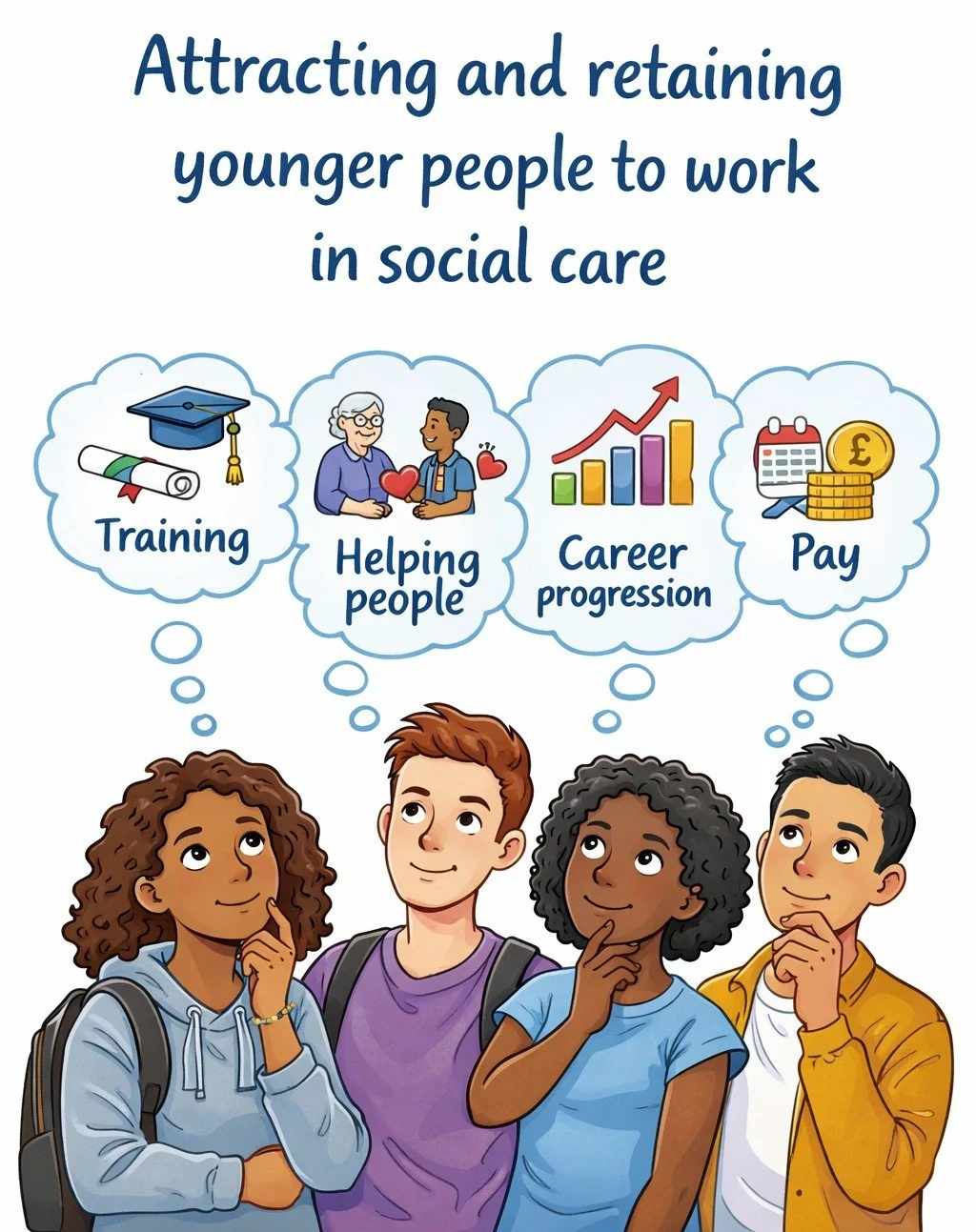
Image by ChatGPT
The Leavers Study is a responsive project, commissioned by the Department of Health and Social Care, and conducted in collaboration with the Health and Social Care Workforce Policy Research Unit. We’re talking to people who were in frontline roles (including social workers, care workers and managers) and asking them why they left the sector and what would have encouraged them to stay. Whilst job quality (pay, hours, etc) is important, retention is also likely to be associated with so called ‘soft’ skills of managers and the culture of organisations. The leavers study aims to draw out key messages and recommendations, focussing on what employers can change now, even within the constraints of the current funding system.
As well as delivering on these studies, a big part of our first year has been about understanding the priorities of the sector and our partners across our four themes. These consultations are shaping the research that we will do next. Here’s how.
National Conversations
Our first year has been about listening. We have undertaken national consultations with national organisations, provider groups, workforce representatives and other stakeholders. The focus has been to identify workforce ideas, innovations and solutions which are primed and ready for evaluation. Having scanned the evidence base, we’ve taken ideas with the greatest potential for impact to our two Community Involvement and Engagement (CIE) groups, all of whom have lived experience of social care or work in front line roles. These groups have helped ensure our priorities are inclusive and grounded in lived experience. Theme leads are now working with local authority and sector partners to prioritise these and develop clear research questions for co-created studies, involving our engaged and active CIE groups every step of the way. By working together, we aim to design robust research projects that can make a real difference across the sector.

Image by ChatGPT
Creating communities
In the autumn we launched the Care Work Community of Practice, an online space where people working in social care, people with lived experience, and the research community can come together to share knowledge and insights. The community has quickly gained traction, with 198 people joining since its launch in November 2025. Engaging with policy makers is as important as engaging with the sector. We have strong links with the Department of Health and Social Care and their delegated healthcare team contributed to our CoP on Delegated Healthcare Activities in December. We have created a space for discussion, shared learning and collaboration. This is valued by members of the CoP:
“The Community of Practice webinars offer an opportunity to look in more depth at specific topics within the Care Work research programme and hear from a wide range of different voices with interesting insights and valuable expertise. Whether it is looking in more detail at the hot topics of digital technology in care and support services or exploring delegated healthcare activity, they are thought provoking and informative.” (Liz Jones, Deputy CEO and Policy Director at National Care Forum)
“The CoPs are very worthwhile for me. The information and talks are interesting and so useful for investigating and understanding Social Care Workforce issues to try and improve and address the complex challenges we face in social care. I really appreciate this community because it provides a space for people who use services and their carers, as well as frontline care and support staff to ask questions and offer feedback. Being involved with this also supports me in my volunteer roles with the Stroke Association, hospice and Housing 21.” (Susan, a CIE Lived Experience Working Group member)
A shared endeavour
Care Work is a collaborative, inclusive partnership, rooted in a shared determination to understand and improve conditions for the social care workforce. We are grateful to the many people across the sector who have taken part in discussions, shared insights, helped shape research ideas and taken part in consultation activities. This involvement strengthens the relevance of our work by focusing on what really matters for the sector and its workforce. We will continue to work together to share findings and mobilise evidence to inform practice and policy together.

Karen Spilsbury (left) and Ann-Marie Towers (right)
at NIHR Social Care Conference, 5th March 2026, London
Photo by Alex Orrow
What Comes Next?
As we move into year 2 of Care Work, we will use what we have learned so far to finalise our research programme, launch additional studies, and deepen our engagement with those working in and drawing on social care. We remain committed to research that supports meaningful change - co-created with, and useful to, the sector.
We look forward to what we can achieve together in the year to come.